|
 |
 |
|
  |
|
|
|
|
|
|
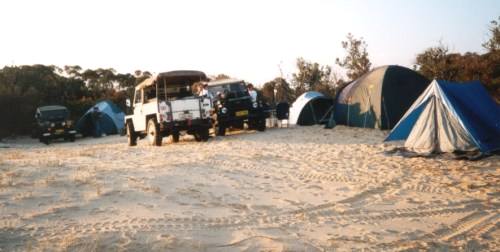
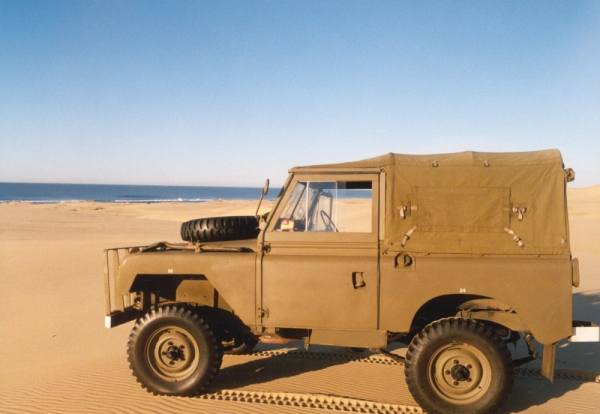
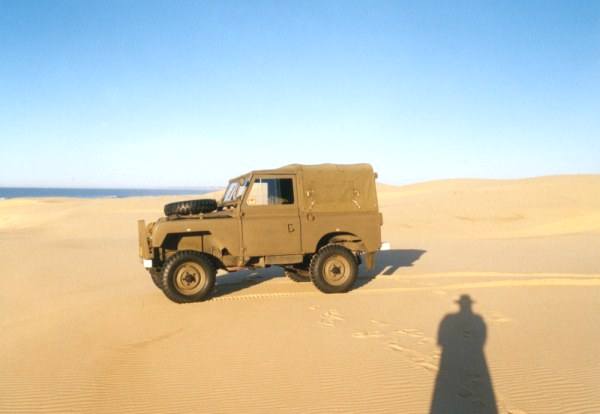
GOOD TIMES AT THE TOP OF TANK TRAP TRACK After fifteen minutes the R & R crews returned from the bush, watched by the video, and walked to the toTTT campsite. We spread out on the flat areas of sand and relaxed. The Lightweight owners began comparisons between the 12v petrol models belonging to Phillip and Ana and the rarer 24v LHD Diesel example called Mr Flat. After all the effort getting up the high dune earlier in the day, most people just wanted a drink and some more chit-chat. The tents starting going up about 4pm and the recovered firewood was made ready. The flag was planted on top of one the giant 'ant hills' beside the campfire and the Land-Rovers were unloaded. The two Range Rovers left camp. The mustard one with Thomas Esser and Scott Fayth went home -they had only intended to spend a day with us- and the blue Range Rover with Mark and Robyn journeyed back north to a motel in Nelson Bay, intending to return about 9am Sunday. What happened out of our sight was that the blue one threw a fan and spent the first half of Sunday finding and fitting a replacement part obtained with the help of the mustard one. That evening, under an almost cloudless sky at the toTTT, was just "top". The BBQ was nice and the beer was cold (thanks to Tracy's big esky). I was confident that we were all pleased with our day's efforts. The main talking point was that big dune and how wrong the weathermen had been. It had been a perfect day and we had a lot to talk about after our dinner as the fire was beefed up and the full moon came up shone down on the white sands. Standing in the firelight with the Southern Cross and other stars overhead we toasted the Aussie Flag, 100 years old come Monday the 3rd of September. Then we toasted the 90th Anniversary of Singleton Army Camp, the 60th Anniversary of nearby Williamtown Air Force Base and the 60th Anniversary of Gan-Gan Army Camp too. And there, on the dunes, illuminated by the moonlight we also toasted the 40th Anniversary of the Series 2A Land-Rover (Solihull September 1961). Some yarns were told and after an hour or so we drifted off to our sleeping bags. Dennis and Graeme slept in the back of their shortwheelbase Landys with the tailgate lowered. One of my teenagers, Scott, slept in the front of Castrol with the seat bases levelled (reversed front-to-back). Syd and Ralph slept in the back of the 110. Everyone else was in a variety of tents on airbeds or on the sand. We all noticed that way out to sea there were flashes in the dark like distant artillery bursts. A big electrical storm had brewed up out there. We didn't know whether we were in for a wet night or dry. Then we noticed that the cloud shadows were sliding over the contours of the moonlit dunes in an easterly direction. Hopefully this meant the storm and thunder would stay out to sea so we could have a good night's sleep; we'll see. My last thoughts that evening were of the servicemen who spent their days nights on watch up here on the bight and on the headlands too. The bight was considered a risk, a likely invasion point, hence all the camps, the OP's, the tank traps and the pickets. The servicemen were stationed all around here from 1942 to 1945, not knowing whether the Japanese would send in a night patrol to neutralise the 'Mark X' guns at Fort Wallace ('Mark X' guns had lethal 284lb shells with a 17 mile range). The 13th Heavy Artillery Battery that stood guard at the Fort protected the Port of Newcastle, the coal mines and the BHP steelworks. Some Japanese 'commando' submarines did put a few cannon rounds into Sydney Harbour and into Newcastle during the war, and there is a local story about a Jap sub being beached in Port Stephens and the Americans packing it off stateside for 'hush-hush' inspection. The night wasn't especially remarkable, except to say that sand is not comfortable to sleep on. (A sleeping bag on the sand is not recommended). The weather stayed balmy and the sunrise was lovely. You had to look at the western horizon to see any cloud at all -- another beautiful sunny day had arrived as per our wish. Some sleepy heads were stirring and the Kookaburras were going full tilt in the bush. I got up and took the camera for a walk up onto the highest point of the dune to our east looking for a good camp photo. Exactly one (1) photo later I was out of film. Duh. I walked back, loaded more film and warmed up Castrol. This time I drove back down the gully and turned south, driving up on to the top of the same big dune I had climbed up the day before and resumed taking photos. This was the highest dune Castrol climbed during the whole R & R. Up on the flat top of the dune there were a few soft-sinky spots but I didn't get stuck since all the camping gear and spare fuel was back at the campsite. Without any load, Castrol seemed unstoppable. It occurred to me that maybe on the next R & R we should organise it like the Cooma event; the entrants just drive in to the camp site and set up. Then they put their name down to tag along on their choice of scheduled trips, taking only food and drinks for lunch. Hmmm. When I returned to camp, breakfast was nearly over and the some tents were coming down. |


| back | next |
© www.remlr.com 2001